Installing a steel storage vault on poorly prepared ground can lead to uneven support, drainage problems, and premature structural stress. So, what ground preparation does a steel storage vault need in New Mexico? The process should begin by evaluating soil-bearing conditions, removing unsuitable material, establishing a properly compacted and level base, and providing adequate drainage around the foundation. These steps matter because New Mexico regulations recognise questionable, expansive, and collapsible soils as conditions that may trigger subsurface investigation, while foundation requirements must account for site-specific soil behaviour. So this guide explains the key ground-preparation considerations before installation, helping property owners understand how foundation preparation contributes to a stable, durable steel storage vault.
| Steel Storage Vault Ground Preparation Overview: Preparing a steel storage vault site in New Mexico requires attention to soil stability, terrain, drainage, climate, and support. Assess soil bearing capacity, expansive or unstable conditions, vegetation, caliche, and unsuitable material before creating a compacted base. Depending on site conditions, gravel, concrete slabs, footings, or piers may be appropriate. Proper runoff control, erosion protection, anchoring, level checks, permits, setbacks, easements, and utility locating support a secure installation. |
What Ground Preparations Are Needed Before Steel Storage Vault Setup and Why?
Evaluate the Soil and Site Conditions
Before steel storage vault setup, evaluate the soil type, bearing capacity, and existing site grade to ensure the vault receives stable, uniform support. New Mexico soil conditions can vary from loose, sandy deposits with limited bearing strength to dense caliche, expansive, or collapsible soils that may require specific subgrade treatment. Where soil strength or settlement potential is uncertain, a geotechnical evaluation can determine allowable bearing pressure and appropriate preparation measures. The site’s natural slope should also be assessed because uneven desert terrain can direct intense monsoon runoff toward the vault. Identifying drainage patterns early allows the finished grade to be designed to divert water away from the foundation and reduce erosion, soil saturation, and uneven settlement.
Clear and Level the Installation Area
- Remove Vegetation, Roots, and Debris: Satisfying level ground requirements begins by eliminating below-surface obstructions that could compromise long-term support. Native species of mesquite and creosote develop deep taproots, extending several feet below the surface. If these are left unaddressed, they can create voids beneath the vault as they decay, leading to localized settling exactly where structural support is needed most.
- Excavate High Spots and Fill Low Areas: As terrain often features a hardened, calcium-carbonate-cemented soil common across the state, it creates uneven high points requiring excavation. However, low areas need engineered fill such as crushed aggregate to fill the voids beneath the vault as it settles under load.
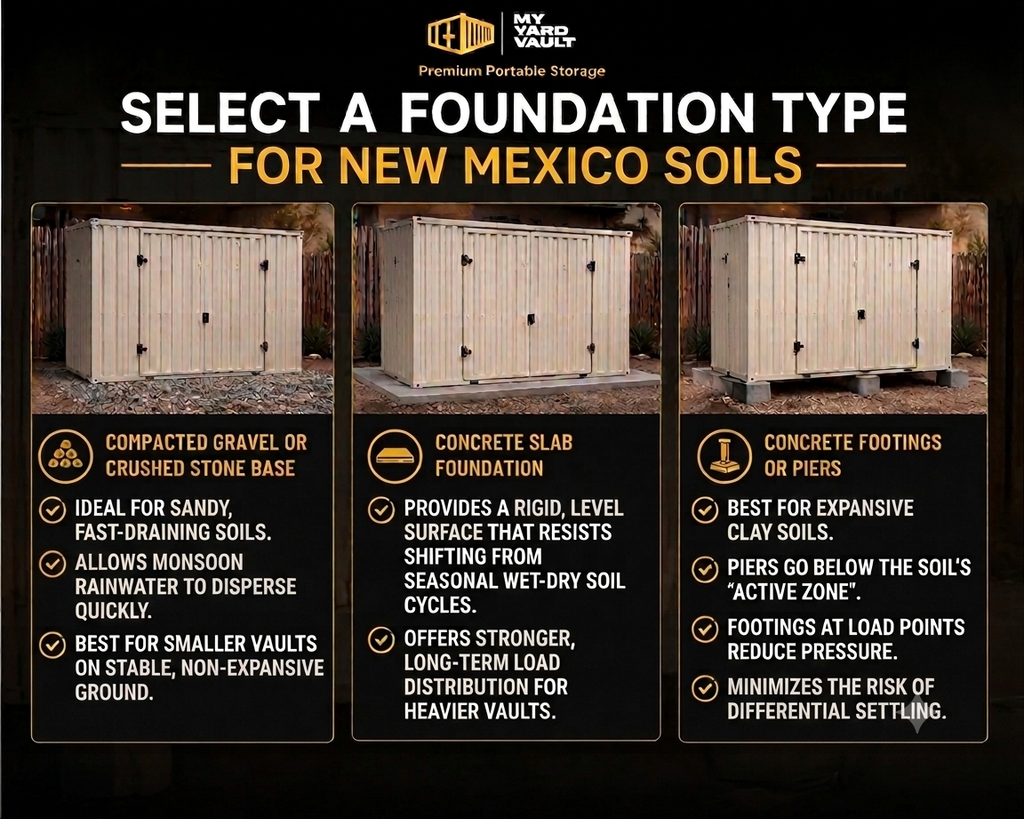
Select a Foundation Type for New Mexico Soils
New Mexico’s soil varies dramatically by region from sandy arroyos to expansive clay, so choosing the right foundation protects your investment from shifting, settling, and monsoon moisture damage over time. Whether you’re planning residential or business steel storage in New Mexico, matching the foundation to local ground conditions helps improve long-term performance and stability.
Plan for Drainage Around the Storage Vault
- Prevent Water From Pooling Around the Base: A compacted gravel or crushed stone layer beneath the vault allows water to drain through. It is especially important in New Mexico’s clay-heavy regions where natural soil absorption is slow. It therefore helps to build the base slightly elevated relative to the surrounding grade, so the steel storage vault sits precisely in New Mexico’s soil with a stable foundation.
- Consider Drainage Channels or French Drains: On flatter New Mexico properties, where minimal natural slope limits gravity-driven runoff, a French drain can be planned as part of the initial site preparation. This typically involves digging a shallow trench along the higher side of the vault, lining it with gravel, and installing a perforated pipe that channels collected water to a safe distance away from the foundation.
Account for New Mexico’s Climate and Ground Conditions
- Manage Monsoon Runoff: Grade the vault pad to shed water away from all sides, and use an uphill berm, swale, or engineered drain where needed. Stabilize discharge points with riprap to keep roof runoff away from the base, and inspect after major storms for scour or diverted flow.
- Address Freeze-Thaw Conditions: At northern or high-elevation sites, support the vault on competent, unfrozen soil or uniformly compacted granular material. Remove moisture-sensitive soils where necessary, maintain perimeter drainage, and prevent snowmelt or irrigation from saturating the pad and causing differential heave.
- Control Erosion on Exposed Sites: Minimize disturbed ground around the vault by compacting backfill and stabilizing pad edges with aggregate, geotextile, mulch, or vegetation. Roughen unpaved slopes along the contour, eliminate downhill tire ruts, and use dust control without over-wetting the subgrade.
Compact the Base Before Installation
A properly compacted granular base creates a dense, uniform support layer for a steel storage vault by reducing voids, limiting water infiltration, and minimizing soft spots, edge settlement, and seasonal soil movement. Aggregate selection is critical; FHWA research indicates density is typically maximized when fines comprise approximately 6–20% of the granular material. After placement and compaction, verify the finished base in multiple directions with a laser or contractor’s level to eliminate dips, crowns, rocking, and loose perimeter areas. The completed, level base should also provide a stable support system for manufacturer-specified anchoring against uplift, sliding, and overturning.
Check Local Building and Site Requirements
- Building Permit Considerations: Under 14.5.2.9 NMAC, “Exceptions to Requirement for Permits,” New Mexico exempts certain one-story detached storage structures of 120 square feet or less from a building-permit requirement, provided they are not used for habitation. However, the exemption is not automatic approval for any location or foundation type; local zoning, electrical, floodplain, drainage, wind-design, and HOA requirements can still apply.
- Property Setbacks and Easements: Locate the vault using a current survey, recorded plat, or jurisdiction-approved site plan, not assumed fence lines or informal boundary markers. Required setbacks vary by municipality, county, zoning district, lot type, and if the vault is classified as an accessory structure, storage building, or equipment enclosure.
- Utility Lines and Underground Hazards: Before excavation for the vault base, identify underground electric, gas, water, sewer, and communications infrastructure. In New Mexico, 811 should be contacted before digging, while privately owned lines may require additional locating because public utility marking does not necessarily identify every private underground service.
Conclusion
Preparing a steel storage vault site in New Mexico requires more than simply leveling the ground. My Yard Vault helps homeowners, contractors, and property owners simplify the installation process with vault solutions suited to site conditions, foundation requirements, and drainage planning. From selecting the appropriate vault to coordinating installation considerations, you gain a more dependable path toward a stable, professionally prepared storage solution for your property.
| So prepare the right foundation and drainage approach for your New Mexico property with My Yard Vault’s storage vault installation support. |
FAQs About Ground Preparation for Steel Storage Vaults in New Mexico
Is caliche difficult to prepare for a storage vault?
Caliche can be hard and cemented, so specialized excavation equipment may be necessary when the existing ground interferes with the planned installation area.
Can rocky ground affect steel storage vault installation?
Yes, large rocks or shallow rock formations can interfere with excavation and may require removal or an alternative site arrangement.
Can a steel storage vault be installed over previously disturbed desert fill?
Only after determining whether the existing fill is properly placed and stable; undocumented fill can behave differently from naturally consolidated soil.
What if the vault site sits beside a septic system in New Mexico?
The proposed footprint should be coordinated with the septic tank, drainfield, and required separation distances so installation work does not damage or restrict the wastewater system.
Can irrigation runoff affect a prepared vault foundation?
Yes; irrigation overspray or leaking lines can repeatedly introduce moisture into nearby ground, so the irrigation layout should be reviewed before finalizing the installation area.